![Logo [with tagline]-38](https://talkingdistance.com/wp-content/uploads/2025/03/Logo-with-tagline-38-300x138.webp)
⏰ Read time : 6 mins
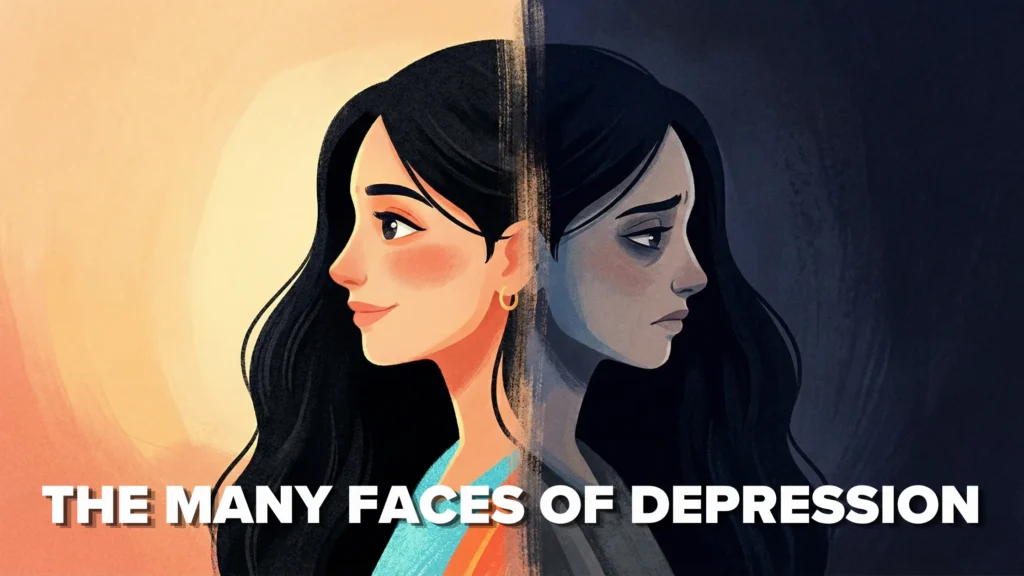
There’s a common image people hold of depression—persistent sadness, tearfulness, a visible heaviness. And while that is real, it’s only one version of a much broader, more complex experience.
Depression doesn’t always look the way we expect it to. Sometimes it’s loud and overwhelming. Other times, it’s quiet, functional, and easy to miss—even for the person living through it.
This is not about diagnosing yourself or others. It’s about expanding awareness. Because when we can recognize the different ways depression shows up, we are better able to respond with care rather than confusion or self-judgment.
Depression Isn’t One Thing
Depression is not a single, uniform experience. It exists on a spectrum, and it can take different forms depending on a person’s biology, life circumstances, personality, and environment. Two people can both be depressed and have completely different inner worlds, and that difference matters. Understanding these variations isn’t about placing yourself into a rigid category. It’s about having language for something that can otherwise feel vague, confusing, or difficult to explain—even to yourself.
Major Depression: When Everything Feels Heavy
This is often the version people recognize most easily, but even here, it’s not just about sadness. It can feel like a deep, persistent heaviness that touches multiple parts of your life at once—your energy, your sleep, your appetite, your ability to feel connected to things that once mattered. What many people notice is a kind of disconnection. Not just from joy, but from motivation, from clarity, and sometimes even from themselves. Everyday tasks can start to feel disproportionately difficult, as though there’s an invisible weight attached to even the smallest actions.
High-Functioning Depression: When Life Looks “Fine” on the Outside
There are forms of depression that exist beneath the surface of a seemingly “normal” life. You might still be showing up to work, meeting responsibilities, and maintaining relationships, yet internally feel exhausted, flat, or emotionally distant. This can create a quiet kind of isolation, because the external markers of struggle aren’t obvious. There’s often an internal pressure to minimize what you’re feeling—“Nothing is really wrong, I should be okay”—which can make it even harder to acknowledge your experience with honesty.
Persistent Depressive Patterns: When It’s Been There for a Long Time
For some people, depression doesn’t feel like a shift—it feels like something that has always been there in the background. It may show up as a long-standing low mood, a tendency toward self-criticism, or difficulty fully experiencing pleasure, even in moments that are objectively positive. Because it’s so familiar, it can start to feel like part of who you are rather than something you’re experiencing. That familiarity can make it harder to question or challenge, but it’s important to remember that long-standing patterns are still patterns—they can be understood, and they can shift over time.
Irritable Depression: When It Looks Like Anger or Frustration
Depression doesn’t always present as sadness. Sometimes it shows up as irritability, restlessness, or a low threshold for frustration. You might notice yourself feeling more reactive, more easily overwhelmed, or more impatient than usual. This can be confusing, especially if you don’t associate anger with emotional struggle. But often, beneath that irritability is something softer—exhaustion, hurt, or needs that haven’t had space to be acknowledged. For many people, irritation is simply a more accessible emotion than sadness.
Situational Depression: When Life Feels Like Too Much
There are times when depression is closely tied to what’s happening around you. Loss, transitions, uncertainty, or prolonged stress can all contribute to a sense of emotional heaviness that feels difficult to move through. In these moments, it’s not necessarily about something being “wrong” within you. It can be a very human response to circumstances that are genuinely difficult. Feeling stuck, overwhelmed, or disconnected in these contexts often reflects the weight of what you’re carrying, rather than a personal failing.
How to Recognize What You’re Feeling
Instead of focusing on whether your experience fits a specific label, it can be more helpful to gently notice patterns. You might ask yourself what has shifted recently, what feels harder than it used to, or where you feel a sense of disconnection—from yourself, from others, or from your life. Recognition doesn’t have to be dramatic or definitive. It can be quiet and gradual, rooted in curiosity rather than judgment. The goal is not to arrive at a perfect answer, but to begin paying attention in a more intentional way.
Why Awareness Matters
When we don’t recognize what we’re experiencing, it’s easy to turn inward in a critical way. You might start to believe that you’re lazy, unmotivated, or somehow falling short, especially if your struggles don’t match the more visible versions of depression. Awareness interrupts that pattern. It allows you to see your experience as something that’s happening, rather than something that defines your worth. Often, what you’re feeling is not a failure—it’s information. It’s your mind and body signaling that something needs care, attention, or change.
Depression is not just something to get rid of as quickly as possible. It can also be something to listen to, with a certain degree of respect and patience. This doesn’t mean staying stuck in it, but it does mean acknowledging that it may be pointing toward something important.
It might be highlighting unprocessed emotions, chronic stress, unmet needs, or environments that don’t feel supportive or aligned. Approaching it this way can shift the focus from self-blame to self-understanding, which is often where meaningful change begins.
You Don’t Have to Figure This Out Alone
If parts of this resonate with you, let that be an opening rather than a conclusion. You don’t need to have everything figured out right away. Awareness is simply the first step in a longer, more compassionate process. Support—whether through therapy, trusted relationships, or small personal shifts—can help you make sense of what you’re experiencing. You are allowed to take your inner world seriously, even if it doesn’t look like anyone else’s. You are allowed to move toward yourself, gently, one insight at a time.
If parts of this resonate with you, you don’t have to figure it out alone.
Talking Distance offers support, starting with a free consultation.