![Logo [with tagline]-38](https://talkingdistance.com/wp-content/uploads/2025/03/Logo-with-tagline-38-300x138.webp)
⏰ Read time : 8 mins
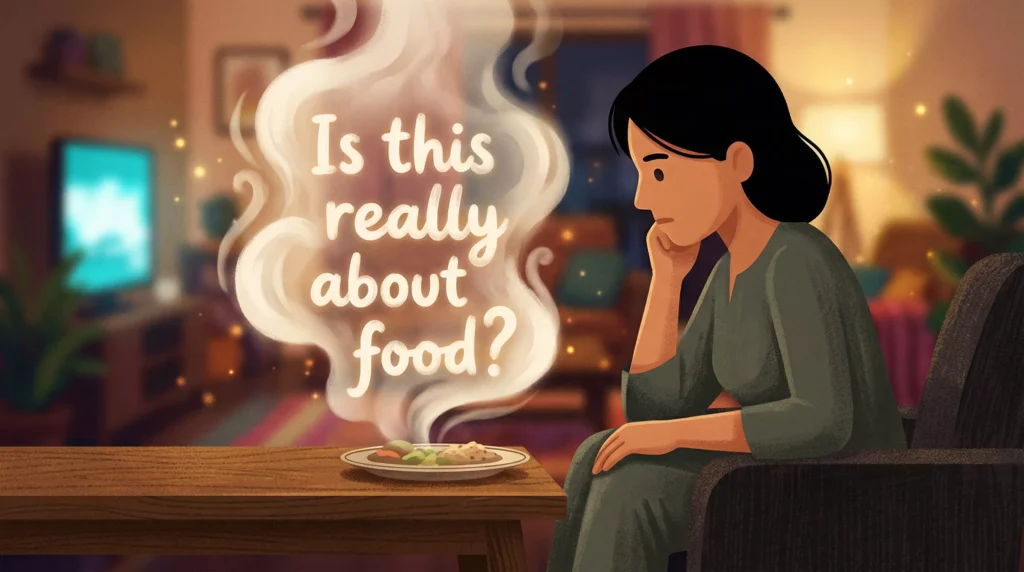
An eating disorder is not simply about food, dieting, or willpower. It is a mental health condition that affects how a person relates to food, their body, and often, their sense of self. While it may show up through eating habits, its roots usually run much deeper; into thoughts, emotions, and ways of coping.
Eating disorders impact both mental and physical health in ways that are often interconnected. Mentally, they can bring persistent anxiety, shame, guilt, and an ongoing preoccupation with food or body image. They can affect mood, relationships, concentration, and how a person sees themselves. Physically, they can disrupt basic bodily functions like energy levels, digestion, hormones, sleep, and overall health. Over time, the body begins to bear the weight of what the mind is struggling to hold. This is why it becomes important to understand that eating disorders are not “phases” or lifestyle choices. They are real, complex conditions that deserve attention and care.
At the same time, recognising them is not about fitting experiences into a neat checklist. It is about gently understanding patterns and noticing when something begins to feel distressing, consuming, or out of balance.
Understanding Different Experiences of Eating Disorders
Eating disorders can look very different from one person to another. They are not always obvious, and they do not belong to one kind of body, personality, or lifestyle. Sometimes they even resemble other mental health concerns, which can make them harder to recognise.
One commonly known experience is anorexia nervosa. In simple terms, this often involves a deep fear of gaining weight and a strong need to control food intake. It may look like eating very little, skipping meals, or creating strict rules around food. On the surface, this can sometimes be mistaken for “discipline” or “healthy eating,” especially in cultures that praise control and restraint. In some cases, the rigid thinking and repetitive behaviours around food can resemble patterns seen in obsessive compulsive disorder, where certain actions feel necessary to reduce anxiety. It can also overlap with traits seen in obsessive compulsive personality disorder, such as perfectionism, a need for control, and strict self-expectations. But underneath, there is often fear, vulnerability, and a sense of self-worth that feels tied to control.
Bulimia nervosa tends to look different, though it also carries its own distress. It often involves cycles of eating large amounts of food in a way that feels out of control, followed by attempts to compensate such as purging, over-exercising, or restricting food afterward. There is often a strong sense of guilt or shame that follows these episodes. Emotionally, this pattern can feel intense and overwhelming, with shifts between distress and attempts to regain control. At times, these emotional ups and downs, along with struggles around self-esteem and impulsive behaviours, can resemble aspects of borderline personality disorder. However, at its core, bulimia is deeply tied to a painful relationship with food, body image, and self-worth.
Binge eating disorder also involves episodes of eating that feel difficult to control, but without the compensatory behaviours seen in bulimia. This is an important difference. After these episodes, there may still be guilt, shame, or discomfort, but not necessarily purging or attempts to “undo” the eating. This experience is often misunderstood or dismissed, but it carries its own emotional weight. It is not simply about overeating, it is about feeling disconnected, overwhelmed, or unable to stop, even when one wants to.
Avoidant or restrictive food intake disorder, often called ARFID, looks different from the others because it is not driven by body image concerns. Instead, it may involve avoiding certain foods due to sensory sensitivities, fear of choking or discomfort, or a lack of interest in eating altogether. It can sometimes be mistaken for “picky eating,” but the impact is much more significant, affecting nutrition, health, and daily functioning.
There are also many experiences that do not fit neatly into these categories but are still valid and deserving of care. Labels can help us understand patterns, but they are not meant to define or limit anyone’s experience.
When Food Becomes More Than Food
Food, in its simplest form, is nourishment. But for many people, it becomes entangled with meaning—control, comfort, punishment, relief, even identity. One of the early signs that something may be shifting is when food starts to carry emotional weight that feels disproportionate or consuming.
This might look like constantly thinking about what to eat, what not to eat, or what was already eaten. It might feel like guilt that lingers long after a meal, or anxiety that builds before one. Sometimes it shows up as rigid rules, unspoken but powerful, that dictate what is “allowed” and what is not.
What matters here is not the behavior itself in isolation, but the intensity and rigidity behind it. The question is not “Do I think about food?” but rather “How much space does this take up in my mind, and how does it make me feel about myself?”
The Body as a Battleground
For many, the body becomes a place of conflict rather than home. There may be a growing dissatisfaction that doesn’t ease, even when external changes occur. Or a sense that one’s worth is increasingly tied to appearance, weight, or shape.
Sometimes this relationship becomes so strained that the body is no longer listened to, but managed. Hunger cues are ignored, fullness is mistrusted, and natural rhythms are overridden by rules or fear. In other cases, the body may feel out of control, leading to cycles of restriction and overconsumption that feel confusing and distressing.
Underneath this is often not vanity, as it is sometimes misunderstood, but vulnerability. A longing for certainty, for safety, for a sense of being “enough.”
Why Eating Disorders Can Develop
Eating disorders are rarely just about food. They often emerge as ways of coping with something that feels difficult to name or hold. For some, it is about creating a sense of control in a world that feels unpredictable. For others, it becomes a way to manage overwhelming emotions—numbing, soothing, or expressing what cannot be easily spoken.
Sometimes these patterns are shaped by earlier experiences—environments where needs were not consistently met, where appearance was heavily emphasised, or where control felt like the only available resource. In other cases, cultural and social pressures around body image, productivity, and perfection can quietly reinforce harmful beliefs over time.
There can also be a deep internal narrative at play—a critical voice that ties worth to discipline, achievement, or appearance. Food and the body then become the medium through which this narrative is enacted.
It is important to understand that none of this happens in isolation. Eating disorders are often the result of many intersecting factors—emotional, psychological, relational, and societal. They are not choices in the way they are sometimes perceived to be. They are responses, adaptations, and, in many ways, attempts to cope.
Control, Coping, and What Lies Beneath
You might notice that food-related behaviors intensify during times of stress, change, or emotional overwhelm. Or that they provide a temporary sense of relief, even if they are followed by guilt or shame.
This is where compassion becomes essential. These patterns, however painful, often serve a purpose. They are not random or meaningless. Recognising this does not mean accepting harm, but it does mean understanding that there is something deeper asking to be seen.
Shame, Secrecy, and Silence
Eating disorders often thrive in isolation. There may be a reluctance to eat in front of others, to talk about habits, or to acknowledge what is happening internally.
Shame can be a powerful force here. It can convince someone that their struggles are not valid enough, not serious enough, or too embarrassing to share. It can also create a sense of disconnection—from others and from oneself.
If you find yourself hiding behaviors, minimizing your experiences, or feeling like you are “the only one,” it may be worth gently questioning that narrative. Silence often protects the disorder more than the person.
A Gentle Turning Point
Recognition does not have to be dramatic. It can be quiet. It can be a moment of noticing, a sentence that lingers, a subtle shift in awareness. It might sound like, “Something about this doesn’t feel right,” or “I didn’t realize how much this was affecting me.” That moment matters.
Not because it demands immediate action or change, but because it opens a door. It creates the possibility of responding differently—with curiosity instead of judgment, with care instead of criticism.
Moving Toward Support
If something in this resonates, it does not mean you have to figure it out alone. Support can take many forms—professional help, conversations with someone you trust, or even simply allowing yourself to acknowledge that your experience is valid.
Healing is not about perfection or complete control. It is about rebuilding a relationship—with food, with your body, and with yourself—that feels more compassionate and sustainable.
And perhaps most importantly, it is about remembering that your worth has never been defined by any of this. Not by what you eat, how you look, or how well you manage it all. There is a person beneath these patterns who deserves care, understanding, and space to exist fully. Awareness is not an endpoint. It is a beginning.
If parts of this resonate, you don’t have to make sense of it alone.
Talking Distance offers support, starting with a free consultation.