![Logo [with tagline]-38](https://talkingdistance.com/wp-content/uploads/2025/03/Logo-with-tagline-38-300x138.webp)
⏰ Read time : 5 mins
There is a moment, just before you leave, that no one prepares you for.
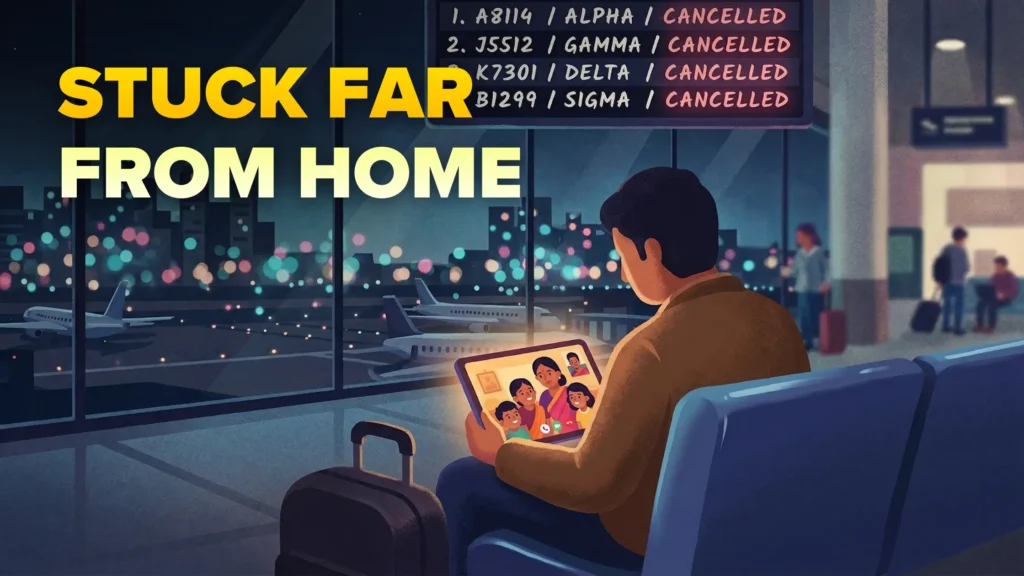
It’s not the packing chaos or the logistical overwhelm. It’s that knot in your stomach while saying goodbye to your parents — the one that sits somewhere between your throat and your chest. You notice details you’ve never paid attention to before: the way your mother’s dupatta slips slightly off her shoulder, the tired kindness in your father’s eyes, the house sounding emptier even though you’re still standing in it. You tell yourself this is necessary. You tell yourself you’re ready.
And yet, your body hesitates.
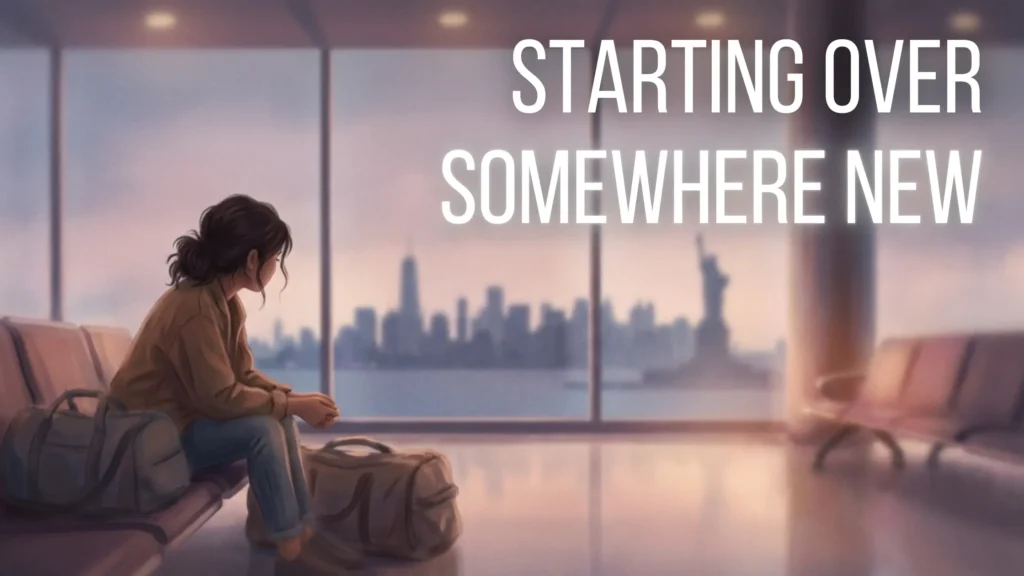
Moving to a new city is often framed as excitement — new beginnings, independence, ambition. But beneath that narrative lives something more complex. It’s a quiet grief. A dislocation. A rewriting of who you are when the familiar scaffolding of your life is suddenly gone.
One of the strangest losses for me was language. I guess we don’t realise how deeply a language holds you until you stop hearing it spoken around you. At home, it wrapped itself around your days without effort — in overheard conversations, street calls, jokes that didn’t need explaining. In a new city, your ears keep searching for it. You lean in when you hear someone speak it on the street. Your body softens when a familiar word floats past you in a café. It is in these instances that language isn’t just communication; it’s memory, emotion, identity. It tells you who you are allowed to be without translating yourself.
And when it disappears, something inside you goes quiet too.
In those early days, everything feels heightened. You notice how your shoulders tense on public transport. How silence in your room feels louder than noise ever did back home. How loneliness doesn’t always announce itself as sadness — sometimes it shows up as restlessness, irritability, or the constant urge to stay busy. You scroll more. You call home more often than you intended. Or less, because it hurts too much.
Then there’s the moment of recognition.
You’re walking through a market or waiting in line somewhere, and you see someone who carries reminders of your home. Maybe it’s the way they dress, the way they speak, the food they’re carrying, the rhythm of their body in space. And suddenly, you feel relief. Not because they know you — but because your nervous system does. Familiarity feels like safety. It tells your body, You belong somewhere in this landscape too.
This isn’t a weakness. It’s biology. It’s how humans survive change.
When we move cities, we don’t just relocate physically — we lose our existing “safe zones.” The places, people, routines, and sensory cues that regulated us without us even realising it. The morning chai with family. The shopkeeper who knew your order. The streets your feet could navigate on autopilot. These were coping mechanisms disguised as normal life.
So in a new city, we begin again — unconsciously creating new safe zones.
Your favourite café becomes a ritual, not because the coffee is extraordinary, but because it’s predictable. That one friend you text daily anchors you. A weekly call home becomes non-negotiable. You find comfort in specific foods, playlists, walks, religious spaces, or even certain routes you take repeatedly. These are not random habits. They are acts of self-soothing. They are your psyche saying, I need islands of safety while everything else feels unfamiliar.
Sometimes, our coping mechanisms are less kind. Overworking. Emotional numbing. Avoidance. Telling ourselves we should be “stronger” by now. Comparing our internal chaos to other people’s curated transitions. These too are attempts to survive — but they often leave us feeling more alone.
This is where therapy can quietly change the terrain.
Therapy offers a safe zone that isn’t dependent on geography. A space where you don’t have to perform resilience or justify your grief. Where someone understands that missing your parents doesn’t mean you regret leaving. That craving familiarity doesn’t mean you’re incapable of growth. That feeling untethered doesn’t mean something is wrong with you.
In therapy, you begin to notice your coping patterns with compassion instead of criticism. You learn how your body responds to uncertainty. You understand why certain losses hit harder than expected. You explore how your identities — cultural, linguistic, relational — shape your sense of safety. And slowly, you learn to build internal anchors alongside external ones.
The empowering part of moving cities isn’t the absence of fear — it’s the ability to hold fear and still choose yourself.
It’s realising that you can miss home and still create one elsewhere. That you can grieve what you left behind without shrinking your future. That safety doesn’t only live in places — it can live in boundaries, self-trust, chosen relationships, and the way you speak to yourself when things feel hard.
One day, you’ll notice the knot in your stomach has loosened. Not because you’ve forgotten where you came from, but because you’ve expanded. You’ve learned to carry your language, your people, your history inside you — while still making room for new versions of yourself.
Moving to a new city changes you. But it doesn’t hollow you out.
It teaches you how to build safety from the ground up. How to listen to your needs. How to belong — not by erasing where you come from, but by honouring it while you grow.
And that, in itself, is a quiet kind of power.
If moving cities has stirred up complicated emotions for you, you don’t have to make sense of them alone. Talking to a therapist can offer steadiness while everything else feels unfamiliar.
You can explore therapy options with Talking Distance here.