![Logo [with tagline]-38](https://talkingdistance.com/wp-content/uploads/2025/03/Logo-with-tagline-38-300x138.webp)
⏰ Read time : 5 mins
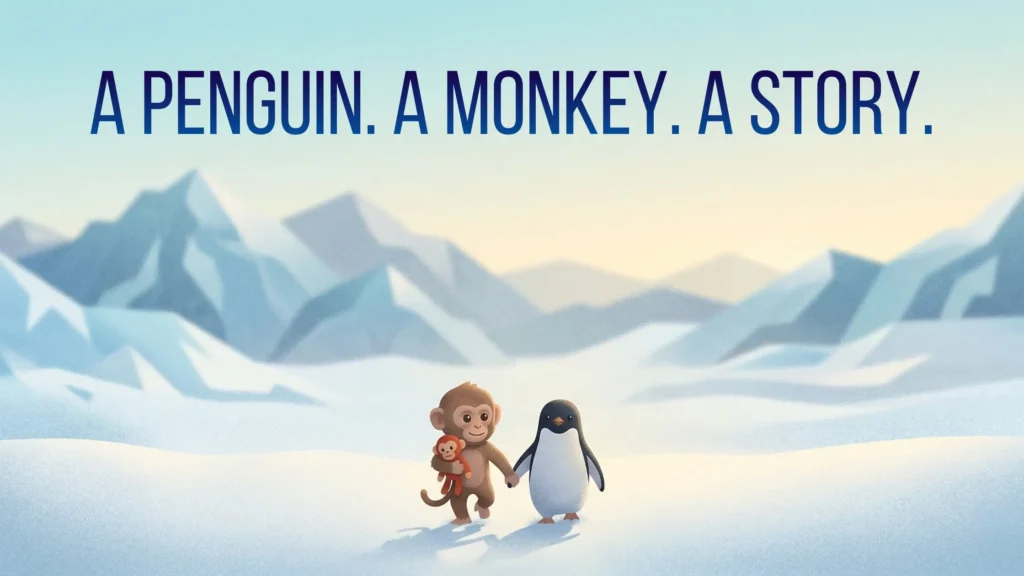
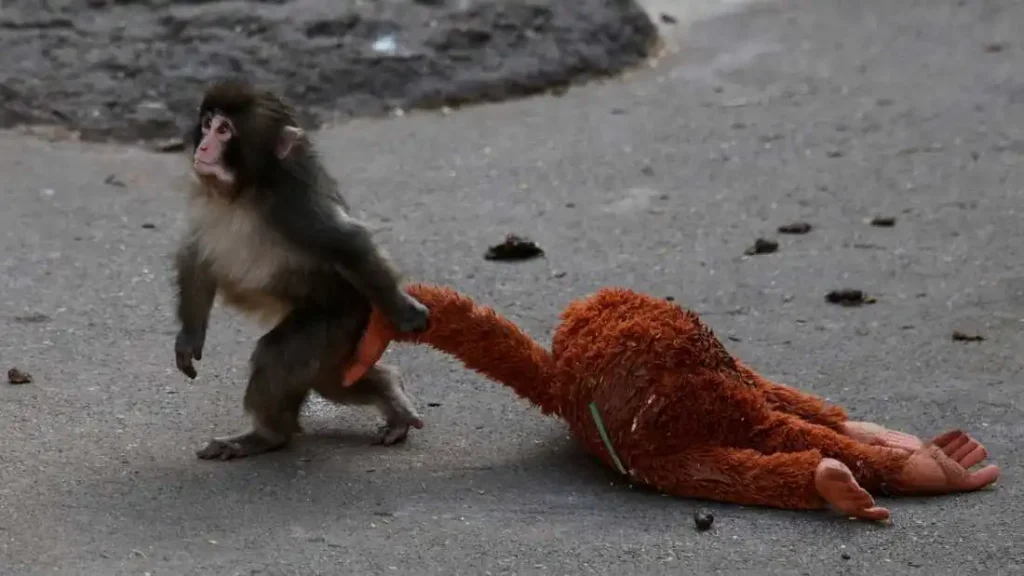
Recently, the internet became captivated by two animals. One was Punch, a baby macaque at Ichikawa City Zoo and Botanical Gardens, who clings tightly to a stuffed toy after being rejected by his mother. The other was a lone Adélie penguin from the documentary Encounters at the End of the World by Werner Herzog, quietly walking away from its colony toward the distant Antarctic mountains. Both stories spread rapidly across platforms like Instagram, Tiktok, etc. People watched the clips and immediately began explaining them. The penguin, they said, was walking away from society. Punch, they said, was the symbol of abandonment and resilience.
But there is something interesting happening here—something deeply human. We were not just watching animals. We were telling stories about them.
When the Mind Fills in the Gaps
In psychology, there is a concept called Confabulation. It refers to the mind’s tendency to create explanations when the real explanation is missing, unclear, or emotionally unsatisfying. Our brains do not like gaps. When something happens and we don’t know why, the mind often fills in the space with a narrative that feels coherent. This doesn’t mean we are lying. It means we are making meaning, which is one of the most powerful things the human mind can do.
The Monkey and the Story of Attachment
Punch’s story is simple in biological terms. Sometimes primate mothers reject their offspring. It can happen because of inexperience, stress, environmental factors, or social dynamics within a troop. But when people watched the videos of Punch clinging to a stuffed toy, that explanation didn’t stay at the surface – instead, something deeper resonated. People saw a baby holding onto the only comfort available to him. They saw vulnerability. They saw survival. For many people, the image quietly echoed something personal: the experience of holding onto something—a habit, a belief, a relationship, an object—simply because it helped us get through a difficult time. The toy in Punch’s arms became symbolic. Not because the monkey intended it to be, but because humans instinctively search for meaning in moments of visible need.
The Penguin and the Story of Isolation
The penguin story works in a different way. In the scene from Encounters at the End of the World, the bird simply walks away from its colony and heads inland. Researchers believe that penguins sometimes wander due to illness or disorientation. Yet when the clip resurfaced online, people immediately attached philosophical meaning to it. The penguin became a metaphor for existential exhaustion, rebellion against the herd, walking away from a system that no longer makes sense. In a world where many people feel overwhelmed or disconnected, the image of a small creature quietly leaving the group struck a powerful emotional chord. Again, the interpretation tells us less about the penguin—and more about us.

A Seagull Who Wanted to Fly Higher
Long before viral videos existed, a similar projection happened in literature in generations before us. In the book Jonathan Livingston Seagull by Richard Bach, a seagull rejects the ordinary routines of his flock and dedicates himself to mastering the art of flight. The story reads like a spiritual allegory about freedom, individuality, and self-realization. The story works because it uses an animal as a canvas for human longing—our desire to transcend limitations and live more fully. And readers embraced it for decades because it articulates something deeply hopeful: the possibility that we can grow beyond the roles assigned to us.
What Confabulation Really Reveals
It is easy to think of confabulation as a mistake—an error in thinking. But there is another way to understand it. Confabulation shows us how strongly the human mind seeks coherence and meaning. When we see the penguin walking away, our minds instinctively ask: What does this mean? When we see Punch clinging to a toy, we wonder: What story is unfolding here? These interpretations often reflect the emotional landscape of the moment. A generation feeling burned out may see the penguin as someone leaving the system. A generation exploring attachment and trauma may see Punch as a symbol of resilience. In this way, the stories we tell about animals become quiet mirrors of our own inner lives.
The Opportunity Inside the Story
There is something empowering in recognizing this. If the mind naturally creates stories to explain the world, then we also have the capacity to examine those stories. Sometimes the narratives we construct are limiting: “I’m the one who doesn’t belong.” “I’m the one who always gets left behind.” “I’m the one walking away because nothing matters.” However, storytelling is not only something the mind does automatically. It is also something we can do consciously. Just as readers once saw themselves in Jonathan Livingston Seagull, we can choose narratives that emphasize growth, curiosity, and possibility. The same image can hold different meanings. A penguin walking away might represent despair—or courage. A monkey holding a toy might represent abandonment—or the remarkable instinct to seek comfort and survive.
The Stories Are Ours
The animals in these viral moments were simply behaving according to instinct. The deeper stories were written by us. And that is perhaps the most important insight. Human beings are meaning-making creatures. We interpret, imagine, project, and reflect. Sometimes this leads us into misunderstanding. But it also allows us to create narratives that help us heal, grow, and make sense of our lives. The question is not whether we will tell stories. We always will. The question is simply this: What kind of stories do we want to live inside?